
Chemistry
NEET Organic Chemistry: The Logic of Reaction Mechanisms
P V SatishSenior NEET Faculty (20+ Years Exp)
February 20, 2026 · Updated November 17, 202615 min readElectron flow. A nucleophile (electron-rich) attacks an electrophile (electron-poor), and the reaction goes through the most stable intermediate available. Inductive, resonance and hyperconjugation effects decide which intermediate is most stable, and that decides the major product.
Many NEET aspirants treat Organic Chemistry like a telephone directory: a long list of named reactions to memorise. It works until the exam changes one group on the molecule. The more reliable approach is to ask one question every time: where are the electrons, and where do they want to go? This guide builds that habit from NCERT's "Organic Chemistry: Some Basic Principles and Techniques" and applies it to the Class 12 reactions NEET asks about most.
Every polar mechanism is an electron-rich source giving a pair of electrons to an electron-poor sink. When a bond breaks heterolytically, one atom keeps both electrons and ions form (carbocations, carbanions). When it breaks homolytically, each atom keeps one electron and free radicals form.
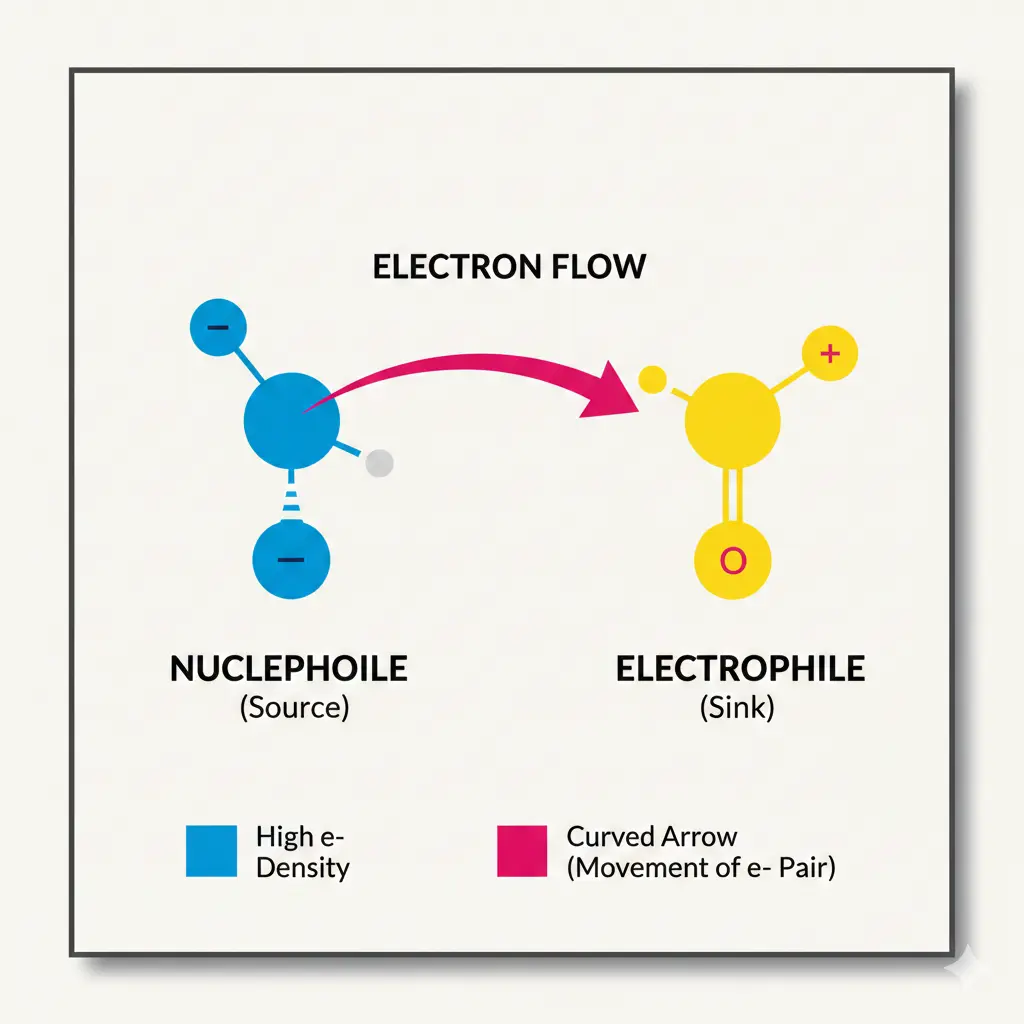
Negative ions or neutral molecules with a lone pair: OH⁻, CN⁻, RO⁻, Br⁻, NH₃, H₂O, R–NH₂. They attack carbon atoms that carry a partial or full positive charge.
Positive or electron-deficient species: H⁺, NO₂⁺, carbocations, BF₃, AlCl₃, and the carbon of a C=O group. They are attacked by π electrons or lone pairs.
These effects explain why electron density is uneven in a molecule, and therefore where a reagent attacks and how stable an intermediate is.
| Effect | What it is | NEET example |
|---|---|---|
| Inductive (I) | Permanent shift of σ-bond electrons towards the more electronegative atom; fades quickly with distance. | −I: –NO₂, –CN, –F, –Cl. +I: alkyl groups. ClCH₂COOH is a stronger acid than CH₃COOH. |
| Resonance (R or M) | Permanent delocalisation of π electrons or lone pairs through a conjugated system. | +R: –OH, –OR, –NH₂, halogens. −R: –NO₂, –CN, –CHO, –COOH. Phenoxide is resonance-stabilised, so phenol is acidic. |
| Hyperconjugation | Permanent delocalisation of α C–H σ electrons into an adjacent empty p orbital or π bond. | More α-hydrogens, more stability: (CH₃)₃C⁺ (9 α-H) > (CH₃)₂CH⁺ (6) > CH₃CH₂⁺ (3) > CH₃⁺ (0). |
| Electromeric (E) | Temporary, complete shift of a π electron pair, only while an attacking reagent is present. | Seen in the C=C or C=O of a molecule at the moment a reagent attacks; disappears when the reagent is removed. |
When effects compete, resonance usually beats induction. The one exception NEET loves is the halogens on benzene: their −I effect makes the ring less reactive, while their +R effect still sends the incoming group to the ortho and para positions.
| Intermediate | Structure | Stability order | Where you meet it |
|---|---|---|---|
| Carbocation (C⁺) | sp², trigonal planar, empty p orbital | 3° > 2° > 1° > CH₃⁺; allyl and benzyl carbocations are extra stable by resonance | Electrophilic addition to alkenes, SN1, E1, dehydration of alcohols |
| Carbanion (C⁻) | sp³, pyramidal, lone pair | CH₃⁻ > 1° > 2° > 3° (alkyl groups destabilise negative charge) | Reactions with strong bases; nucleophilic attack on carbonyls |
| Free radical (C•) | Neutral, one unpaired electron | 3° > 2° > 1° > CH₃• | Halogenation of alkanes, peroxide effect with HBr |
| Carbene (:CCl₂) | Neutral carbon with only six valence electrons | Electron-deficient, so it acts as an electrophile | Reimer–Tiemann reaction of phenol |
CH₃–CH=CH₂ + HBr → CH₃–CHBr–CH₃ (2-bromopropane)
NEET takeaway: Markovnikov's rule is not a separate fact to memorise; it is the reaction choosing the more stable carbocation.
CH₃–CH=CH₂ + HBr (peroxide) → CH₃–CH₂–CH₂Br (1-bromopropane)
NEET takeaway: Same stability rule (more substituted radical), different intermediate, opposite product. Works only with HBr.
CH₂=CH–CH(CH₃)₂ + HCl → CH₃–CH₂–CCl(CH₃)₂ (major: 2-chloro-2-methylbutane)
NEET takeaway: Whenever a carbocation forms next to a more substituted carbon, check for a 1,2-hydride or methyl shift before writing the product.
(CH₃)₃C–Br + H₂O → (CH₃)₃C–OH | CH₃–Br + OH⁻ → CH₃–OH
NEET takeaway: SN2 reactivity: CH₃X > 1° > 2° > 3°. SN1 reactivity: 3° > 2° > 1°, with benzylic and allylic halides especially fast. For the same alkyl group, iodides react fastest (R–I > R–Br > R–Cl).
CH₃–CHBr–CH₂–CH₃ + alc. KOH → CH₃–CH=CH–CH₃ (major) + CH₂=CH–CH₂–CH₃ (minor)
NEET takeaway: Aqueous KOH favours substitution (alcohol); alcoholic KOH favours elimination (alkene). Read the reagent carefully.
Phenol + CHCl₃ + aq. NaOH, then H⁺ → salicylaldehyde (2-hydroxybenzaldehyde)
NEET takeaway: Say it aloud while tracing the arrows: "Chloroform plus base makes dichlorocarbene; phenoxide attacks it at ortho; hydrolysis gives salicylaldehyde."
Cl₃C–COOH > Cl₂CH–COOH > ClCH₂–COOH > CH₃COOH. More −I groups stabilise the carboxylate ion more.
Phenol > water > ethanol. Phenoxide is resonance-stabilised; the ethyl group's +I effect destabilises ethoxide.
o- and p-Nitrophenol are more acidic than phenol (−R, −I of NO₂); cresols are less acidic than phenol (+I of CH₃).
(C₂H₅)₂NH > (C₂H₅)₃N > C₂H₅NH₂ > NH₃, a balance of +I effect, solvation by water and steric hindrance.
(CH₃)₂NH > CH₃NH₂ > (CH₃)₃N > NH₃. Note the change in position of the tertiary amine compared with ethylamines.
Aniline is weaker: the nitrogen lone pair is delocalised into the benzene ring.
HCHO > CH₃CHO > CH₃COCH₃, because of increasing steric hindrance and +I effect.
Much less reactive than alkyl halides: resonance gives the C–X bond partial double-bond character. –NO₂ at ortho/para positions increases their reactivity.
Trap: Peroxide reverses addition for HCl, HBr and HI.
Correct: Only HBr shows the peroxide (Kharasch) effect.
Trap: Carbanion stability follows the carbocation order.
Correct: It is reversed: CH₃⁻ > 1° > 2° > 3°, because alkyl groups push more electron density onto an already negative carbon.
Trap: SN2 on a chiral halide gives a racemic product.
Correct: SN2 gives inversion of configuration. Racemisation is the SN1 signature.
Trap: Tertiary halides are best for SN2.
Correct: Steric crowding blocks backside attack: SN2 reactivity is CH₃X > 1° > 2° > 3°.
Trap: Halogens on benzene are activating because they are o/p directing.
Correct: They are deactivating (−I wins) but o/p directing (+R decides position).
Trap: Aniline is more basic than ammonia because it is an amine.
Correct: Aniline is less basic: its nitrogen lone pair is delocalised into the ring.
Trap: Ethanol is more acidic than water.
Correct: Alcohols are weaker acids than water; phenol is stronger than both.
Trap: The inductive effect is felt along the whole chain.
Correct: It weakens rapidly and is negligible after about three bonds.
Alkyl groups push electron density towards the positive carbon through the +I effect and through hyperconjugation with their α C–H bonds. A tertiary carbocation such as (CH₃)₃C⁺ has three alkyl groups and nine α-hydrogens, so its positive charge is spread out the most. The order is 3° > 2° > 1° > CH₃⁺.
Only for HBr. In the presence of a peroxide, HBr adds to an unsymmetrical alkene by a free-radical mechanism, so the bromine ends up on the less substituted carbon: propene gives 1-bromopropane. HCl and HI do not show the peroxide effect.
Look at the carbon carrying the leaving group. Methyl and primary halides react mainly by SN2 (one step, backside attack, inversion of configuration). Tertiary halides react by SN1 (carbocation intermediate, racemisation), helped by polar protic solvents. Benzylic and allylic halides are very reactive in SN1 because their carbocations are resonance-stabilised.
Halogens withdraw electrons from the ring by their strong −I effect, which makes the ring less reactive towards electrophiles. But their lone pairs donate electron density by resonance (+R) specifically to the ortho and para positions, so the electrophile that does react goes there.
Two reasons. Sterically, a ketone's carbonyl carbon has two alkyl groups crowding the approaching nucleophile, while an aldehyde has one. Electronically, two alkyl groups (+I) reduce the positive character of the carbonyl carbon more than one does. So HCHO > CH₃CHO > CH₃COCH₃.
Revise bonding and hybridisation in the Chemical Bonding and VSEPR guide, learn every reagent and product in the NCERT Organic Name Reactions guide, then listen to the reaction logic in the Chemistry Vault and test yourself with chapter quizzes.
"In my two decades of teaching in Kota and Mumbai, I've seen that students who use multi-sensory tools like VocoStudy diagrams and AudioHub notes consistently score 15-20% higher than those using traditional rote methods. Start syncing your senses today."
P V SatishSenior NEET Faculty (20+ Years Exp)